Ulaanbaatar to Resume Altered Tuul Expressway Project Following Route Redesign and Civil Protests
 Ч.Сумъяабазар
08 сарын 23, 2026

ULAANBAATAR, Mongolia — In a decisive policy pivot concerning Ulaanbaatar’s urban infrastructure and environmental protection, Mayor of Ulaanbaatar B.Purevdagva announced during the United Nations COP17 desertification conference on August 21, 2026, that the suspended Tuul Expressway construction project will resume after significant modifications to its original route along the Tuul River.
The announcement revives one of Mongolia’s most ambitious transport infrastructure initiatives, reframing the megaproject to balance Ulaanbaatar’s severe traffic congestion against critical ecological preservation along the capital city’s primary water artery.
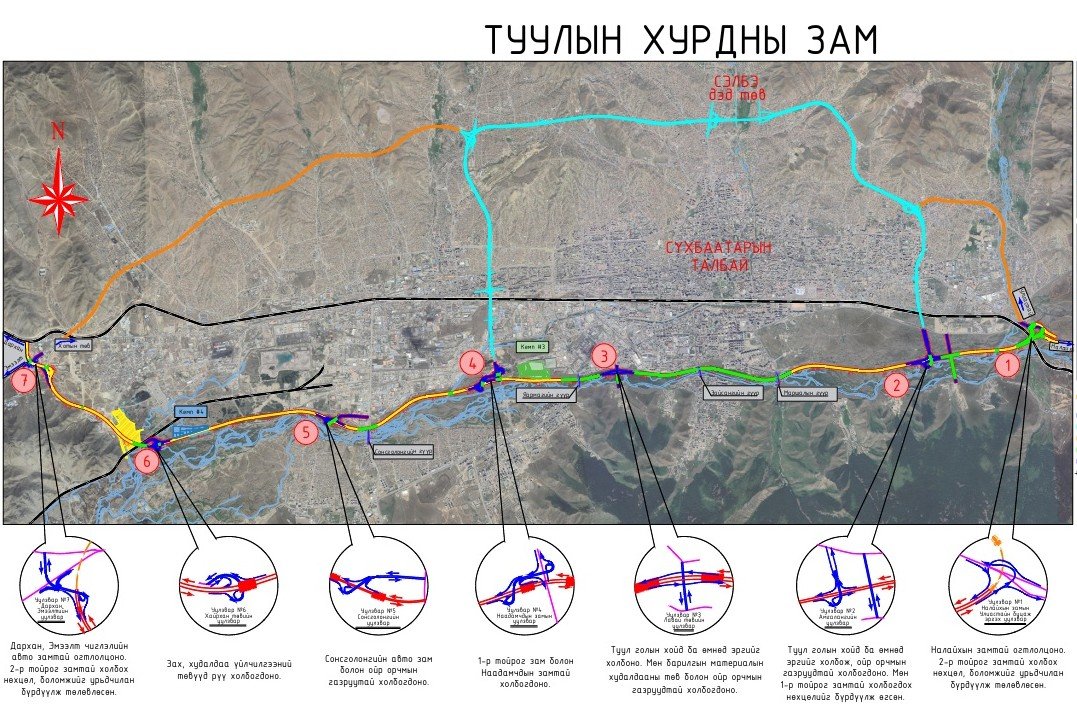
Redesigning a megaproject: Route changes and scope
The Tuul Expressway project was originally conceived as a high-capacity, grade-separated highway designed to bypass Ulaanbaatar's dense urban core. Spanning approximately 32 kilometers in total length, the expressway stretches from the Bayanzurkh Checkpoint at the eastern entrance of Ulaanbaatar—connecting the Ulaanbaatar–Nalaikh highway—all the way to the westernmost roundabout leading toward the western provinces near the 22nd Checkpoint.
Under the contract awarded on August 5, 2025 to the primary general contractor, Hong Kong-based Haoyuan Industrial and Trade Co., Limited, the project represents an unprecedented engineering undertaking in Mongolian highway history. To bridge the river basin’s complex terrain and manage seasonal floodwaters, the massive structural scope includes:
- Bridges and Culverts: Construction of 9.8km long bridge structures will be built in 13 different locations and elevated flyovers, complemented by 54 reinforced concrete culverts designed to maintain natural hydrological drainage.
- Exits and Interchanges: A total of 10 grade-separated interchanges and exit ramps engineered to divert heavy freight traffic away from central Ulaanbaatar arterials. Elevated crossings will be built in 8 different locations. 190m long tunnel will be built in four locations.
- Raw Material Quantities: Estimates for the build call for over 450,000 cubic meters of high-grade structural concrete, roughly 65,000 metric tons of steel rebar, and over 1.2 million cubic meters of crushed aggregate and asphalt materials.
Speaking on the sidelines of COP17, Mayor Purevdagva emphasized that while the engineering parameters remain critical for moving Ulaanbaatar’s heavy vehicle traffic, the alignment itself must adapt. "We cannot pursue development at the expense of our ecological survival," Mayor Purevdagva stated. He noted that the city government is altering the project alignment (tras) away from the immediate riverbed and riparian protection zones of the Tuul River to minimize environmental damage while preserving the expressway's functionality.
Financial transparency and previous administration controversies
The decision to redesign and restart the expressway follows intense scrutiny over project financing and execution. Earlier in April 2026, former Mayor Kh.Nyambaatar addressed public concerns regarding advance payments made to the general contractor, confirming that the municipality had disbursed an advance funding package of MNT 500 billion to Haoyuan Industrial and Trade Co., Limited to mobilize equipment, secure raw materials, and begin preliminary engineering earthworks.
Former Mayor Nyambaatar defended the disbursement at the time, stating that funding allocations were necessary to advance the construction schedule and that additional tranches would be provided if work proceeded as planned. However, mounting financial questions and procedural disputes quickly turned the expressway into a central political flashpoint in Ulaanbaatar.
Grassroots protests, environmental backlash, and leadership change
The Tuul Expressway project was formally halted following widespread public outrage and sustained civil protests that ultimately led to the political downfall of the previous city administration.
Civil society groups, environmental activists, urban planners, and local residents mounted fierce demonstrations across Ulaanbaatar, uniting under slogans aimed at protecting the Tuul River (Khatan Tuul)—the vital lifeblood supplying drinking water to the city's 1.6 million inhabitants.
Primary grievances raised during the protest movement included:
- Ecological Destruction: Activists warned that building a concrete six-lane highway directly along the riverbank would destroy protective alluvial soil layers, clear ancient willow forests, and disrupt permafrost thaw cycles, accelerating the degradation and drying up of the Tuul River basin.
- Water Security Threats: Hydrologists cautioned that heavy construction and runoff from thousands of daily motor vehicles would contaminate Ulaanbaatar’s main central groundwater collection wells situated in the Tuul valley.
- Allegations of Corruption: Protesters labeled the project a "mega-corruption scheme", alleging a lack of open international competitive bidding, opaque financial terms regarding the MNT 500 billion advance payment, and land speculation along the proposed expressway route.
The intense public movement culminated in mass rallies outside the Mayor's Office, putting immense political pressure on municipal leadership. The public backlash played a major role in forcing the resignation of former Mayor Kh.Nyambaatar and prompting the incoming city management under Mayor B.Purevdagva to immediately freeze construction.
By adjusting the alignment route to bypass sensitive river protection zones while maintaining key structural components—such as the planned bridges, culverts, and interchange nodes—the current city leadership aims to deliver the long-awaited bypass road while respecting public demands for environmental stewardship.
Холбоотой сэдвүүд
cop17 cop17 mongolia пүрэвдагва туулын хурдны зам улаанбаатар
Санал болгох







Сэтгэгдэл бичих
Та сэтгэгдэл бичихдээ бусдад хүндэтгэлтэй хандана уу. Ёс бус сэтгэгдлийг Peak.mn сайт устгах эрхтэй.